

Are Incisors Hard To Repair Cavities
Abstract
Teeth incorporate a living tissue called dental pulp, enclosed within a hard, outer shell made of enamel and dentin. The dental lurid keeps the teeth live by providing oxygen, nutrients, and the nervus supply to each tooth. Molar cavities (also called caries) and injury tin can destroy the hard beat out of the molar and, when the injury is deep, information technology tin impairment the pulp. Infection and inflammation in the pulp can atomic number 82 to the death of the tooth. With a method called pulp regeneration, scientists aim to bring the life dorsum to a dead molar. In the near future, information technology might be possible to regenerate teeth in diverse shapes and sizes, and even accept those new teeth resemble the missing teeth.
What Is a Tooth Fabricated of and What Happens When It Is Damaged?
Imagine a fruit with a hard, outer shell encasing a soft lurid inside. The structure of a tooth is similar, with a hard, outer, white casing made up of substances chosen enamel and dentin, and a soft inner cherry pulp (Figure i). The white part of the tooth, which is visible in the rima oris higher up the gingiva (gums), is called the crown. The part of the tooth that holds it in the os is chosen the root. Both the crown and the root accept dental pulp in their centers. Dental pulp is rich in blood vessels and fretfulness, which provide oxygen and nutrients to the molar, keeping information technology alive or "vital". Additionally, our mouths are home to millions of bacteria. Some of these bacteria protect the body, while others eat the sugars present in the mouth and convert it to acid. This acrid amercement the teeth and causes cavities, which are also called caries. Enamel and dentin are the kickoff barriers against both bacterial infections and other trauma to the teeth, and they protect the dental pulp.
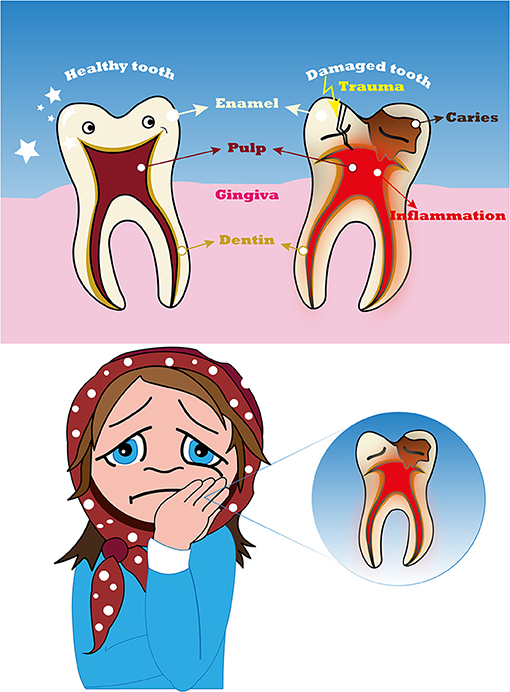
- Figure 1 - A healthy tooth (left) and a tooth damaged by cavities or trauma (right).
- Symptoms of pulpitis, which is inflammation of the tooth pulp, include pain and swelling. This is why regenerative therapies are needed to help patients when a molar dies. With new, promising, lurid-regenerative approaches, it will exist possible to get a new, vital tooth to supercede a lost or damaged tooth.
When an injury or infection crosses the initial barrier of dentin and enamel, the pulp activates its repair cells, called stem cells. Stem cells fight infection with the help of immune cells, and they repair the damaged parts of the molar past regeneration (re-growth) of dentin and os. During regeneration, the blood vessels in the pulp expand. The lurid starts sending some signals that may be felt every bit hurting or every bit sensitivity to hot or cold temperatures. Likewise, the enamel may turn slightly pinkish. This process of expansion and pain is called inflammation of the lurid, or pulpitis (Figure i). If the infection/injury is not controlled at this stage, the lurid tin can expand until it is choked inside the hard, outer instance and dies, giving the tooth a grayish-bluish color. This is called pulp necrosis. In more severe injuries, the damage and infection may cantankerous the root and spread into the surrounding os.
The age of a person at the time of a tooth injury is an important factor in deciding the treatment options. In the case of immature adults, the careful preservation of good for you or vital pulp is critical for the completion of root formation leading to a healthy tooth. The treatment in this instance is called vital pulp therapy, because some vital lurid is left behind. In adults, the root is completely formed, and then the infected pulp tin be replaced with an appropriate material to block the tooth from further infection and increment its strength. This treatment is called non-vital lurid therapy, because all the pulp is removed.
How Do Dentists Currently Heal and Replace Damaged Teeth?
Over the final decade, rapid progress has been made in the field of lurid therapies to heal injured teeth [one]. As mentioned before, handling options available to preserve the lurid are chosen either vital or non-vital lurid therapies. Vital pulp therapy, as well chosen pulp capping, is similar to applying a rough-and-tumble with some medicine onto the live pulp. The purpose of vital lurid therapy is to preserve the pulp tissue and keep it salubrious, specially in young adults whose teeth take been partially affected by caries or trauma. Vital pulp therapies are based on the ability of the lurid to repair itself, in the absence of infection [two]. Most ordinarily, calcium-based medicines are used to care for the pulp in the crown of the tooth and restore its vitality. Later on healing the pulp, the damaged enamel and dentin are replaced with tooth-colored materials called composites, or silver-containing night metallic fillings.
Not-vital pulp therapy, also chosen root canal treatment, refers to the removal and cleaning of the dead, infected pulp from the crown and root of the tooth. In a root canal, the damaged pulp is replaced with a suitable textile to provide strength to the molar. In this treatment, thorough cleaning and disinfection of the root canals is done using diverse chemicals and cleaning instruments. The make clean canal created in the tooth root is then filled with a prophylactic-like material chosen gutta-percha, which strengthens the roots when it hardens. Finally, the damaged tooth crown is replaced by an artificial ceramic crown. For infections that accept reached the bone, surgeries are carefully performed past drilling a hole in the os, cutting away the infected part of the root and the surrounding os, cleaning the area, and covering the damaged surface area with a calcium-based medicine, for healing. This procedure is called an apicoectomy. The major drawback of non-vital pulp therapies is that, since no vital pulp is left behind, the tooth loses its capacity to repair and regenerate itself. This makes the roots more brittle and prone to fracture, which can cause leakage of the dental chemicals from the root into the bone and can make the tooth prone to greater structural harm [3].
How Is Science Improving the Methods of Healing Damaged Teeth?
In contrast to not-vital pulp therapy, which involves the removal of infected lurid, at that place are some new experimental therapies that focus on bringing back the lost vital lurid to the tooth, including its blood and nerve supplies. This new approach is called regenerative endodontics, and information technology consists of three basic parts: (1) stem cells to re-grow the missing pulp; (2) a scaffold or matrix to abound the new cells on; and (3) molecules for increasing the growth and formation of the new lurid, called growth and betoken factors [four] (Effigy 2). By combining these iii basic tools, the pulp can exist regenerated and the vitality of the tooth can be maintained. Currently, these therapies are performed generally in laboratories. Every bit scientific advances continue, however, these therapies may exist practiced on patients in dental clinics in the future. In laboratories, scientists utilize various cells from animals and humans to test the new materials and their rubber. The findings from these tests are used to develop models that are very similar in part and form to the human tooth and pulp. Such models are called 3D tissue models [5]. The effect of various drugs, dental materials, and handling procedures can be performed on these models before the new treatments are tested on animals or humans.
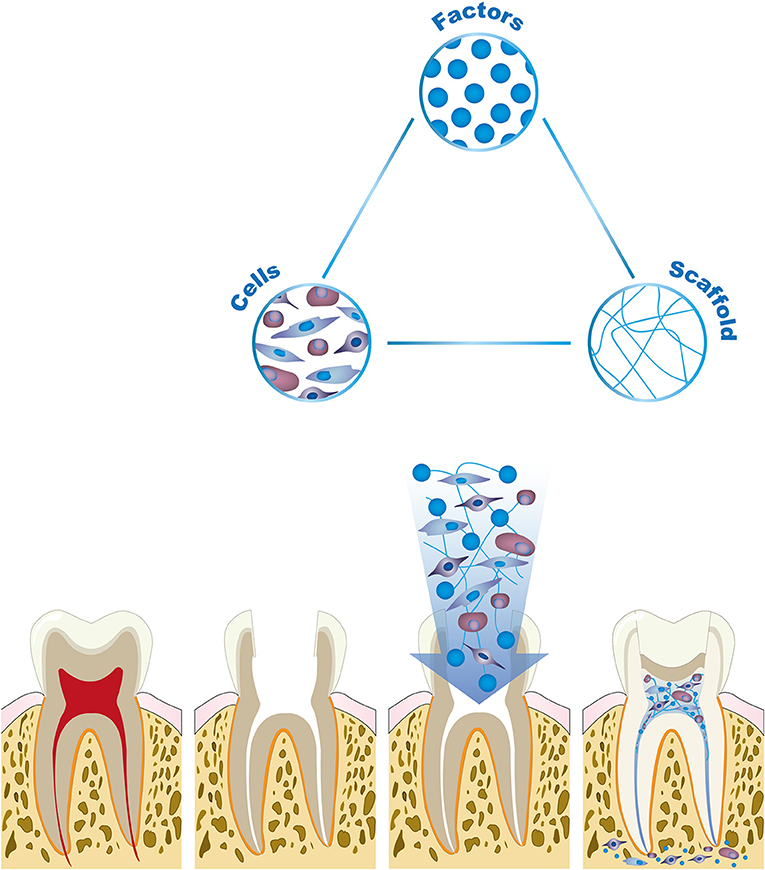
- Figure ii - Molar and pulp regeneration is based on tissue engineering enquiry, which aims to rebuild lost torso parts and organs.
- The "building blocks" of molar and lurid regeneration are stem cells, substances (factors) for increasing the growth of the new lurid, and a matrix or scaffold for the cells to abound on. In the future, these strategies will help to generate new lurid for a dead tooth.
Some research is showing that lurid tissue tin exist regrown even in the absenteeism of a scaffold or matrix [4]. It is also possible that new research will eventually let the regeneration of not only the pulp, but besides the hard, outer shell of the tooth as well! When this arroyo is ready to exist used in patients, it will be a major advocacy in the current handling strategies.
Conclusion: Skilful News for Damaged Teeth!
With such promising approaches for regenerating tooth pulp, information technology will be possible give a patient a new, vital tooth to replace a lost or damaged molar. This new tooth would perform all the functions of a vital tooth. With further advancements in regenerative endodontics and 3D printing, it will be possible to produce teeth in diverse shapes and forms that will be clones of the missing teeth!
Author Contributions
GO, KJ, and HA were involved in design, literature research, writing, and submission of the manuscript.
Glossary
Regeneration: ↑ The process of total healing after an injury.
Vital Lurid Therapy: ↑ Handling which aims to preserve and maintain pulp tissue that has been injured but not fully destroyed and bring it back to a alive good for you state.
Not-vital Pulp Therapy: ↑ Treatment involving total removal of the pulp and filling of the canal with a suitable material to maintain the tooth in a not-infected country.
Endodontics: ↑ In Greek, Endo means "inside" and Odont means "molar." Information technology is the dental specialty concerned with the study and treatment of the dental lurid.
Conflict of Involvement Statement
The authors declare that the enquiry was conducted in the absenteeism of any commercial or fiscal relationships that could be construed as a potential conflict of involvement.
References
[1] ↑ Athanasiadou, East., Paschalidou, G., Theocharidou, A., Kontoudakis, N., Arapostathis, G., and Bakopoulou, A. 2022. Biological interactions of a calcium silicate based cement (Biodentine™) with stalk cells from human exfoliated deciduous teeth. Dent. Mater. 34:1797–813. doi: 10.1016/j.dental.2018.09.014
[2] ↑ Dhar, Five., Marghalani, A. A., Crystal, Y. O., Kumar, A., Ritwik, P., Tulunoglu, O., et al. 2022. Use of vital pulp therapies in primary teeth with deep caries lesions. Pediatr. Dent. 39:146–59.
[3] ↑ Asgary, S., Fazlyab, Thousand., and Nosrat, A. 2022. Regenerative endodontic treatment versus apical plug in young teeth: three-year follow-upwardly. J. Clin. Pediatr. Dent. 40:356–60. doi: x.17796/1053-4628-40.5.356
[4] ↑ Janjić, Grand., Cvikl, B., Moritz, A., and Agis, H. 2022. Dental lurid regeneration. Int. J. Stomatol. Occl. Med. eight:1–9. doi: ten.1007/s12548-015-0139-1
[5] ↑ Itoh, Y., Sasaki, J. I., Hashimoto, M., Katata, C., Hayashi, M., and Imazato, S. 2022. Lurid regeneration by 3-dimensional dental pulp stem cell constructs. J. Dent. Res. 97:1137–43. doi: ten.1177/0022034518772260

Source: https://www.frontiersin.org/articles/437128
Posted by: sundberggrayoucand.blogspot.com
0 Response to "Are Incisors Hard To Repair Cavities"
Post a Comment